

ISSN:1671-4709
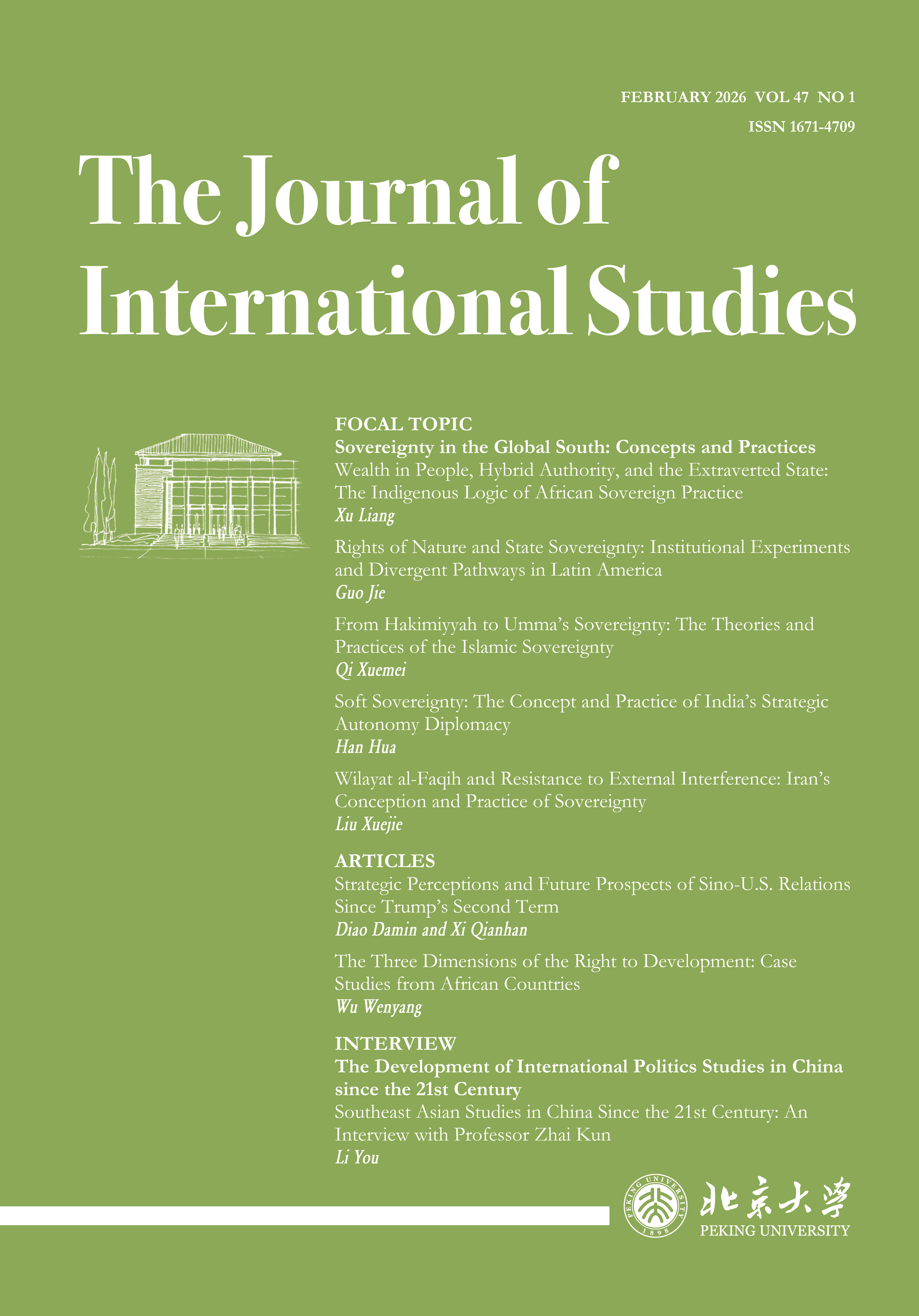
Latest Issue:Volume 47,Number 1,
April 2026
THE JOURNAL OF INTERNATIONAL STUDIES is a bimonthly academic journal sponsored by Peking University and published by the School of International Studies of Peking University and the Society of China Association of Higher Education. As a leading journal in international studies in China, it is open to contributions by Chinese and foreign scholars and invites submission of academic articles on international relations theories, international security, international political economy, area studies as well as Chinese politics and foreign policy.
African countries have consistently advocated, promoted, and put into practice the right to development. At the global level, African countries have pushed for the standard making of the right to development through their statements and voting behavior, putting forward demands aimed at improving the international order and development environment. At the regional level, the African Charter on Human and Peoples’ Rights was the first to enshrine the right to development. Through its implementation, it has affirmed the rights of minority groups, such as indigenous peoples, to participate in the development process and has clarified the standards for this right. At the national level, five representative African countries-Cameroon, Uganda, Malawi, Ethiopia, and South Africa-have implemented the right to development through their constitutions and development plans. This demonstrates the significance of the right to development in safeguarding economic and social rights and addressing livelihood issues such as poverty alleviation and employment.
Since Trump’s second term, China and the United States have articulated their updated respective strategic perceptions of the bilateral relationship in different forms. Rather than serving merely as retrospective statements, these strategic perceptions have functioned as a critical foundation for the overall stability observed in Sino-U.S. relations during this period. Since the beginning of Trump’s second term, Sino-U.S. relations have maintained overall stability under the strategic guidance of head-of-state diplomacy and through sustained high-level consultations. Such stability has manifested itself in three dimensions: continued decoupling in areas involving core national competitiveness, a pattern of competitive engagement combined with sustained consultation in areas concerning concrete and practical interests, and the maintenance of limited spillover in areas where both sides seek to avoid being drawn into open conflict. Such stability has been jointly shaped by adjustments in both countries’ perceptions of themselves, of each other, and of the bilateral relationship, together with corresponding policy adaptations. Whether Sino-U.S. relations can sustain stability in the future will depend on the evolution of bilateral strategic perceptions, the ways in which they shape policy choices, and the continuity of stabilizing factors provided by both sides.
Iran’s concept of sovereignty has deep historical and religious continuity, with its core lying in the foundation of “Allah’s sovereignty.” It grounds political legitimacy within a religious framework and institutionalizes it within the state power structure through the “Wilayat al-Faqih.” Iran’s practice of sovereignty exhibits a dual logic, both internal and external. Domestically, Iran has developed a hybrid political structure in which religious authority, represented by the Supreme Leader, occupies the highest position, modern state institutions provide the operational framework, and limited forms of popular participation are permitted. In foreign relations, this conception of sovereignty translates into a systematic rejection of external interference and continues to shape Iran’s fundamental positions on issues such as the nuclear question, regional affairs, and relations with the United States.
Against the backdrop of intensifying major power competition and the transition of the international system from unipolarity to multipolarity, India has emerged as a major strategic variable influencing the evolution of the global balance of power. However, the rise in India’s strategic significance has not yet been accompanied by a definitive “side-taking” between the United States, Russia, and China; rather, it is characterized by persistent multi-alignment diplomacy. The concept of “soft sovereignty” offers an effective explanatory framework for India’s diplomatic behavior. This study argues that the recurring practice of strategic autonomy in Indian diplomacy essentially manifests a form of functional sovereignty, centered on the right to strategic choice, the veto power over formal alliances, and the ultimate discretion in decision-making.
Contemporary Islamic sovereignty thought includes the theories of “Sovereignty of Allah,” “Guardianship of the Jurist,” and “Sovereignty of Umma”, represented respectively by Abu Ala Mawdudi, Ruhollah Khomeini, and Rachid Ghannouchi. All three confirm the “Hakimiyyah,” differing in that Maududi emphasizes the exclusivity of the “Allah’s sovereignty” and denies “human” sovereignty. Khomeini stresses the necessity of an Islamic government and the guardianship of the jurists, whereas Ghannouchi explicitly affirms the “popular sovereignty.” All three employ Western political concepts such as sovereignty and democracy, but Mawdudi and Khomeini’s narratives carry stronger Islamic characteristics, while Ghannouchi incorporates more Western elements. The theories of Hakimiyyah and Wilayate Faqih justify Islamic democracy and rule of law, significantly differing from the notions of “Hierocracy” or the “Divine Right of Kings” in European history. Ghannouchi’s social contract thought inherent in his theory of “Umma’s sovereignty” closely resembles that of Locke. In the institutional practice of contemporary Islamic countries, popular sovereignty is more commonly observed than the hakimiyyah, with the latter remaining a political claim of Islamist forces.
Since the early twenty-first century, the idea of the rights of nature has increasingly moved from normative debate into institutional practice across Latin America, raising new questions about sovereignty, resource governance, and the ecological foundations of political authority. In Ecuador, the constitutional recognition of the rights of nature grants nature direct legal standing, while in Bolivia ecological principles are embedded in the constitutional narrative and further articulated through subsequent legislation. Yet where extractive development models remain largely intact, a persistent gap has emerged between constitutional commitments and governance practices, limiting their regulatory impact. Elsewhere, particularly in Colombia and Peru, the rights of nature have taken shape mainly through judicial rulings that grant ecosystems legal standing in specific disputes. Courts have occasionally used these rulings to address administrative failures or governance gaps, but this pathway remains highly dependent on social mobilization and judicial interpretation and has proven difficult to institutionalize more broadly. In several other countries, the rights of nature continue to appear in local conflicts, social movements, and constitutional debates without becoming fully embedded in national institutions.
Modern sovereign practices originating from the West are built upon three core pillars: territoriality, absolute internal authority, and the equality of sovereigns. Breaking away from the Eurocentric paradigm of sovereignty, this article proposes a three-dimensional framework to understand African sovereign practices based on indigenous traditions and experiences. First, the historical logic of “wealth in people” emphasizes that authority stems from the control over populations rather than fixed territory, marking a significant departure from the principle of territoriality. Second, the hybrid authority structures in African states, characterized by the long-term coexistence of modern elected governments and traditional chieftaincy. Third, the extraverted nature of African states, where political elites actively absorbing and utilizing external resources as domestic political capital to maintain regime survival and growth, is a key feature that diverges from the principles of sovereign equality and exclusive jurisdiction.